Master's Program Environmental Psychology/Human-Technology Interaction
Are you interested in actively contributing to the key transformation processes of our time as a psychologist? Then the master's program Environmental Psychology/Human-Technology Interaction is the right choice for you! The program has been offered at the Institute of Psychology at Otto von Guericke University Magdeburg (OVGU) since 2025. It is unique in Germany and opens a wide range of career prospects—for example, in non-governmental organizations, consulting and research institutes, companies or public institutions.
What does the master's program entail?
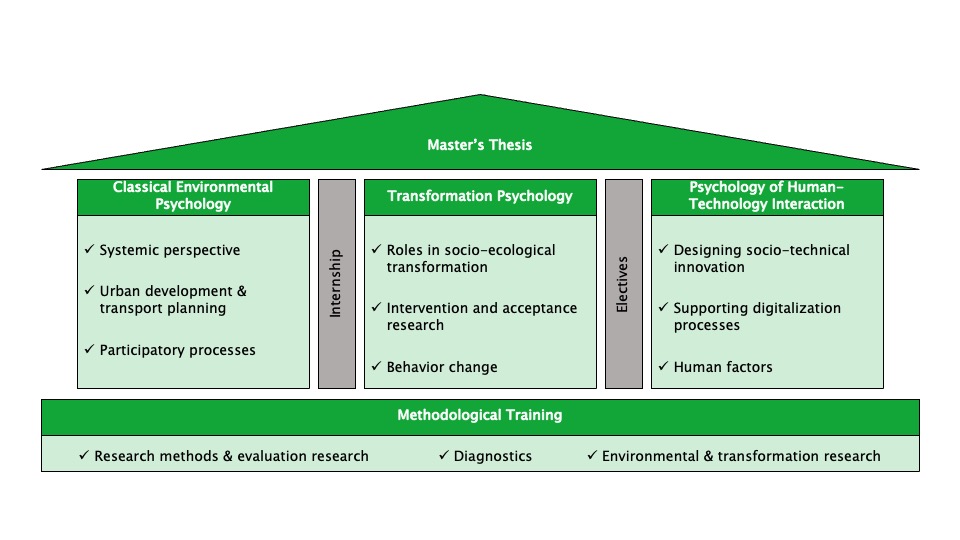
The master's program qualifies students to meet current and future socially relevant transformation challenges with psychological skills. The focus is on the major topics of climate change mitigation, climate adaptation and the preservation of biodiversity, as well as the human-oriented design of socio-technical change processes—for example, in the context of artificial intelligence or the digitization of work and everyday life. The program provides students with in-depth specialist knowledge as well as methodological and analytical skills, enabling them to critically evaluate scientific findings and act responsibly in interdisciplinary and transdisciplinary contexts. Broad, competence-oriented methodological training forms the backbone of the program. In terms of content, the master's program aims to activate the potential of psychology in a targeted manner to support the transformation processes described above. Within this framework, the program is based on three pillars: classic environmental psychology, transformation psychology, and the psychology of human-technology interaction. The integration of these three pillars is unique among master's programs in Germany.
As part of their methodology training, students acquire in-depth knowledge in the areas of research methods, evaluation research and diagnostics. In addition, they examine the particularities of research practice and specific methodological approaches in environmental and transformation research. In the field of classical environmental psychology, the focus is on sharpening a systemic perspective that embeds human action in physical and social contexts. Topics covered include the design of environments—for example, in the context of sustainable urban development or integrated transport planning—as well as the application of participatory processes. In the field of transformation psychology, the course content focuses on the different roles in which people can contribute to socio-ecological transformation as individuals and as part of groups, for example as consumers, citizens or activists. Findings from intervention and acceptance research are also incorporated in this context. In the field of human-technology interaction, students develop planning skills for dealing with socio-technical innovations. Students learn to empower individuals in actively shaping and constructively coping with the diverse changes in an increasingly technology-driven work and living environment, for instance, with regard to new forms of mobility.
Why study with us?
Small class sizes enable interactive teaching and learning formats and intensive, direct supervision of students. In order to ensure a high degree of practical orientation, in-depth career counselling is also offered in this context. In addition, a wide range of opportunities for active participation in ongoing projects are available. The departments involved in the master's program cooperate with universities and research institutes in numerous countries, including Norway, the Netherlands, Japan, the USA and Cambodia.
To promote intercultural skills and engage with international research, all students have the opportunity to spend a semester abroad. As part of the European Union's Erasmus+ program, there is the possibility of a partially funded stay abroad, for example, at NTNU Trondheim in Norway or at the universities of the EU Green Alliance. In addition, most of the courses in the summer semester are held in English and are conducted jointly with students from international partner universities. This creates a sustainable intercultural exchange in an open and constructive teaching and learning atmosphere.
Application for the master's program Environmental Psychology/ Human-Technology Interaction
Applications for the master's program must be submitted to OVGU's Department of Academic Affairs by 15 July. The program starts annually in the winter semester and has restricted local admission. Up to 20 students are admitted each year. Visit the university's website for international students for more information. regarding general application information
Already enrolled in our master's program?
Do you have any questions about the course of study? We recommend reviewing the study and examination regulations, as well as the module handbook
for students who began their studies before the winter semester 2025/26
Ready to write your thesis? Here you can find an overview of possible topics and supervisors as well as previous theses by fellow students.
Teaching staff of the department:
- Prof. Dr. Ellen Matthies
- Dr. Anke Blöbaum
- Jun. Prof. Dr. Karolin Schmidt
- M.Sc. Andreas Deuß
- Dr. Theresa Sieverding
Questions about the master's program?
Department of Environmental Psychology
Email: upsy.master@ovgu.de